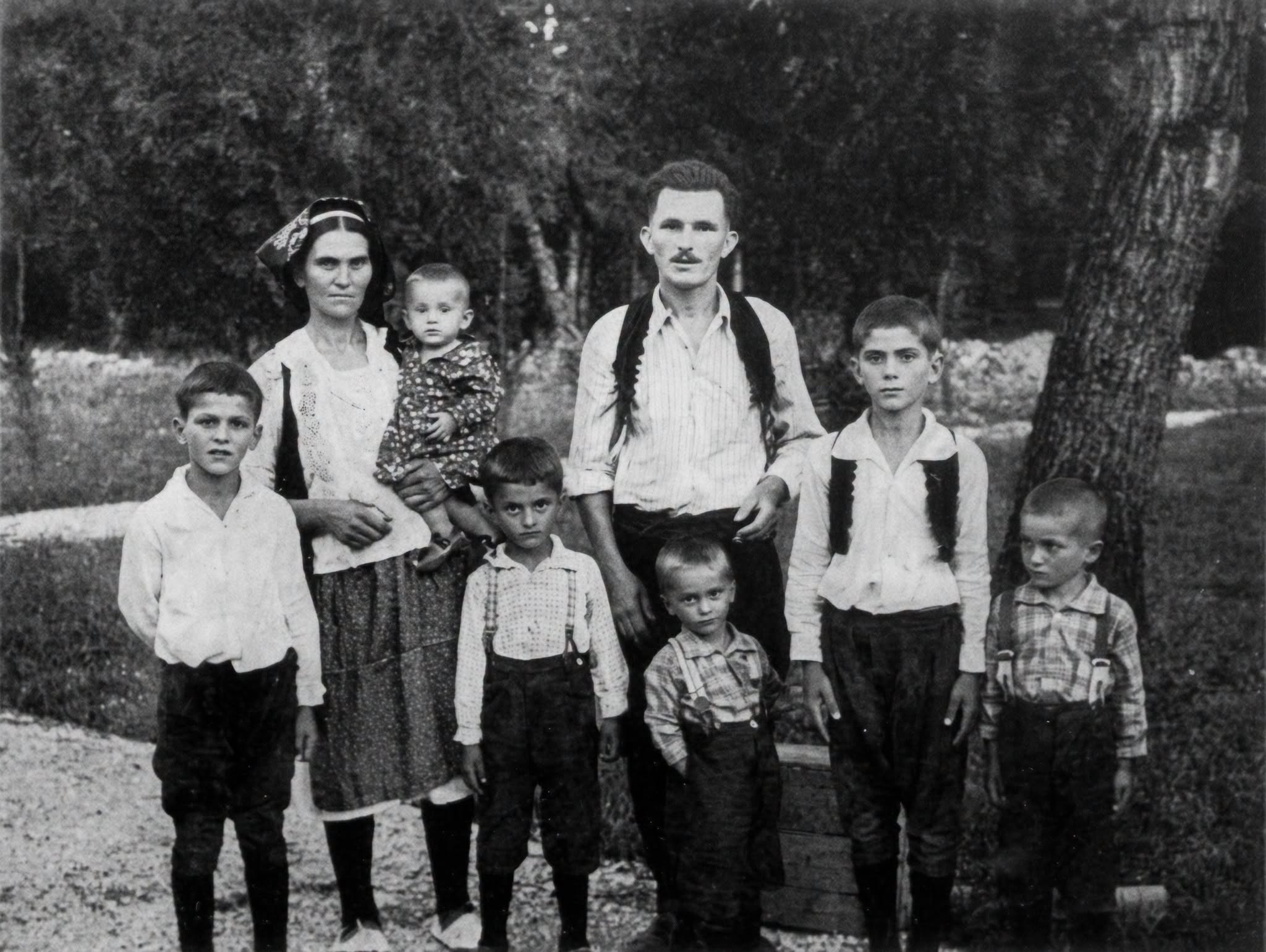
An analysis published in Napredak’s Croatian National Calendar for 1938 reveals that the primary cause of widespread poverty in Herzegovina is its high birth rate and the subsequent fragmentation of land ownership. Dr. Vencel Kosir’s detailed report, accompanied by a poignant 1937 photograph of the Ivačka and Milica Marušić family from Mokro with their six sons, underscores how large families, despite being a sign of health, paradoxically lead to economic hardship in the region. The article argues that Herzegovina is “poor in bread because it is rich in children,” a stark reality for numerous families like the Marušićes, whose ancestral land diminishes with each passing generation.
Kosir’s study highlights Herzegovina’s severe overpopulation as the core issue, rendering temporary relief measures insufficient. Efforts such as increased tobacco prices—which briefly quieted calls for aid in the past year—or the ambitious drainage projects for the region’s 17 major flooded fields, including Bekijsko, Mostarsko Blato, and Popovo Polje, are deemed inadequate for a lasting solution. The problem is exacerbated by an uneven distribution of inhabitants and arable land, particularly in the Mostar, Ljubuški, and Stolac districts, which account for over half of Herzegovina’s population but less than a third of its land area, leaving them critically overpopulated and with little room for agricultural expansion beyond existing tobacco cultivation.
The Marušić family serves as a vivid illustration of this demographic pressure. Brothers Mate and Jozo Marušić from Mokro, near Široki Brijeg, once shared a substantial holding of approximately 40,000 square meters of arable land and 60,000 square meters of forest. Following World War I, their inheritance was divided, leaving Jozo, with his three sons Rudo, Ivačko, and Božo, with 20,000 square meters of arable land and 30,000 square meters of forest. Ivačko, now with six sons of his own—the eldest only 12—is entitled to a third of his father’s share: 6,500 square meters of arable land and 10,000 square meters of forest. Projecting further, his oldest son’s future inheritance would shrink to a mere 1,100 square meters of arable land and 1,660 square meters of forest. With Ivačko’s wife, Milica, being only 29 years old (born 1908), the prospect of more children means even further division and diminished prospects, reflecting the regional average where Herzegovinian women typically bear seven to eight children.
Given these challenges, Dr. Kosir proposes systematic resettlement to more fertile and less densely populated regions as the only viable long-term solution. He advocates for the relocation of Herzegovinians to areas such as Bosnia, Posavina, and Slavonia, where land is significantly cheaper and more productive. While land in Herzegovina fetches 3 to 6 dinars per square meter, comparable plots in Slavonia can be acquired for 1 to 2 dinars, and in Bosnia for as little as 0.25 to 1 dinar. Furthermore, Slavonian land yields two to three times more produce, potentially increasing a Herzegovinian farmer’s income by six to ten times for the same effort. Although Bosnian land, excluding Posavina, may not offer significantly higher yields than Herzegovinian soil, its agricultural output is more stable, less susceptible to natural disasters like hail, drought, and strong winds, and better suited for livestock and fruit farming.
To facilitate this large-scale migration, Kosir suggests establishing a financial institution, possibly Napredak’s own cooperative, to offer credit to Herzegovinians. These loans would be secured by their existing properties in Herzegovina, enabling them to purchase homes and land in the new regions. The ease of selling Herzegovinian land, coupled with the inherent desire of Herzegovinians for land ownership, would ensure that initial investments are quickly recouped and properties expanded. A permanent intermediary, working through organizations like Napredak, Gospodarska Sloga, and Seljačka Sloga, would be crucial for identifying available land and connecting it with prospective settlers. This systematic approach, Kosir believes, could immediately enable the emigration of 10,000 families from the Mostar and Ljubuški districts alone.
Other potential solutions are dismissed as impractical or temporary. The prospect of industrialization in Herzegovina to absorb the workforce is deemed unlikely, and therefore not a topic for serious consideration. Even the ongoing bauxite mining operations are seen as a fleeting resource, expected to last only a few years, offering only a temporary boost that might, at best, aid in the process of emigration rather than providing a sustainable local economy. Dr. Kosir’s analysis firmly concludes that without systematic resettlement, the deep-seated economic crisis in Herzegovina will persist.